


You may have longer than you think, and why it matters.
Investors underestimate how long they will be invested. Suppose you consider someone entering the workforce today. In that case, it is reasonable to assume that they have a 70-to-75-year investment time horizon, consisting of 40-plus years of investing for retirement and 30 years’ of living off their accumulated investments in retirement.
Yes, this is an extreme example but even someone mid-way through their working career realistically has a 40-to-50-year remaining investment time horizon. Unfortunately, underestimating your investment time horizon often makes you too risk-averse to what should be viewed as long-term investments.
Time horizons are longer than you think
To better understand and illustrate investor holding periods, SA Investment Platform Ninety One analysed the average holding period of clients invested in various products on the Ninety One Investment Platform. The results are shown in the chart below. To determine the average holding period, they divided the average assets over the year in each product by any outflows from that product over the same year.
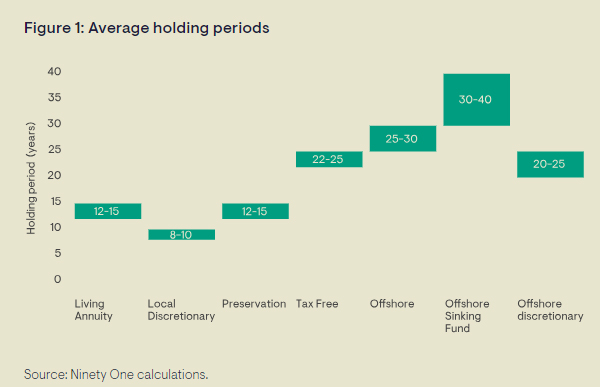
Consider then, that the average holding period of an offshore investment is around 30 years, while even that of a local discretionary investment is at least eight years! The key take-out is that once an investor has decided to invest, they tend to stay invested. Unfortunately, however, the challenging market conditions of the past few years have resulted in investors being far more conservative in how they invest. An analysis of ASISA net flows into collective investment schemes shows that most inflows have been into income funds at the expense of equity and multi-asset funds. The sad reality is that most investors are not letting their money work hard enough for them.
With this holding period insight, one can now, with a greater degree of confidence, recommend a more growth-oriented investment solution. This is important, as it is mostly through investing in growth assets that you can confidently generate attractive real returns over the long term – after tax and inflation.
‘Risky’ assets on average earn a higher return over the longer term, but at the cost of short-term volatility. By way of illustration, the long-term real return (after taking inflation into account) for South African equities (the FTSE JSE All Share Index) has been around 7% per annum over the last one hundred or so years. This is materially higher than the real return offered by more conservative asset classes (cash and bonds), which have only been around 1–2% per annum.
Time is on your side
As we know, a key concern for many investors is the downside risk associated with local and offshore equity and growth-focused multi-asset investments. However, the longer the investment horizon, the greater the degree of certainty of outcome. The following chart illustrates that over shorter periods, while pure equity investors run the risk of a negative return over the short term, we see that as the investment time horizon lengthens, the risk of a negative return dissipates. What is also noteworthy is the fact that there was no rolling five-year negative return when investing in the All-Share Index over the last 20 years.
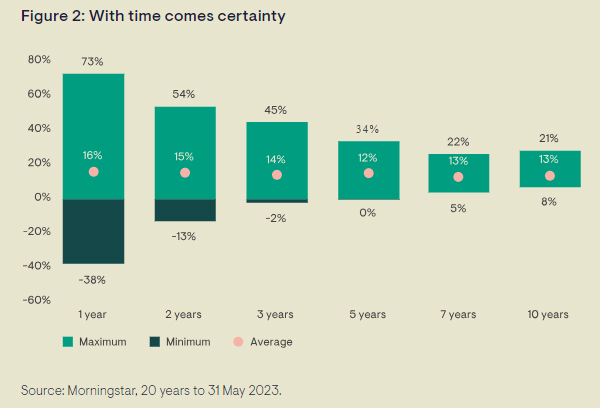
If you now acknowledge that you are likely to have a longer holding period than you had previously thought and understand that you need higher exposure to growth assets to grow your wealth and mitigate the strangling effects of inflation and tax over time, you will be ready to allow your investments to enjoy better growth Even if you are risk-averse by nature, you need to start thinking long-term. This is particularly true when considering that the key output of most financial planning exercises is the estimated investment return required to maintain your standard of living in retirement and that in most instances you will need to be more aggressive in your investments than you may be comfortable with. The reward is clearly very real.
You pay your money, and you take your chances
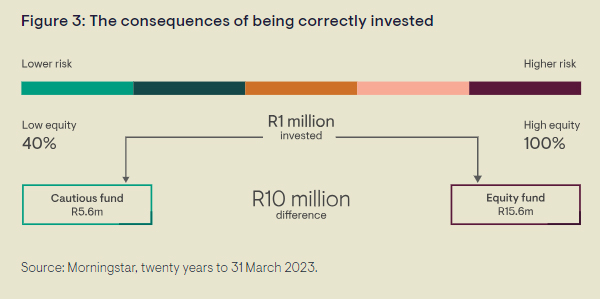
Consider the outcome for a long-term investor who, unmoved by the above argument, invested in a cautious fund as opposed to being correctly invested in an equity fund. The following chart illustrates the consequences, where a R1 million investment in the average multi-asset low equity fund (a proxy for a cautious investment) on 1 April 2003 would have returned R5.6 million at the end of March 2023, whereas the same R1 million invested in the average South African equity fund would have returned R15.6 million!
What is right for you?
We work with you to understand, inter alia, your investment horizons and the appropriate portfolio for that minimum period that will minimise the chance of a loss over that time and maximise the returns that you can expect. Get in touch if you want to explore this more.
This article was slightly adapted from Paul Hutchison’s work here.