


Tax-free Investment accounts (TFIs) were introduced in 2015 to encourage South Africans to save more. Ten years later, we now have a sufficiently long track record to analyse whether investors are maximising the material benefits that they offer.
With ten years of data now available, it is possible to analyse whether investors are taking full advantage of Tax-Free Investments (TFIs). Despite the tax-free advantages of TFIs for long-term investing, investors are making simple mistakes that can impact the material benefits they offer.
Mistake #1: When you contribute
Solution #1: Maximise your annual TFI contribution, early in the tax year
Maximising any tax benefit is an important consideration, as is appreciating that the earlier you start earning investment returns, the earlier those investment returns start compounding.
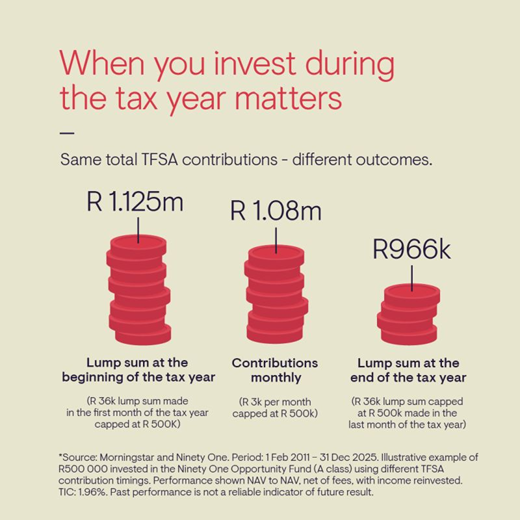
Analysis undertaken by the Ninety One Investment Platform (Ninety One IP)* shows that simply by investing in their Ninety One Opportunity Fund via a TFI at the beginning of each tax year, as opposed to the end of the tax year, would have resulted in as much as an additional 16% payout after 15 years! And, for those who could not commit to an investment of R36 000 at the beginning of each tax year, it would have still been more financially rewarding to initiate a monthly debit order of R3 000, compared to investing R36 000 at the end of each tax year.
Mistake #2: Not investing in sufficient growth assets
Solution #2: Over the long-term, growth assets do the heavy lifting
Based on the current annual limit, it will take new investors nearly 11 years to reach the lifetime contribution limit of R500 000. This is a key consideration, as the tax benefits of TFIs compound exponentially over time.
Unlike your retirement or pension fund, which cannot hold more than 75% in equities, TFIs have no such restriction. You can – and given a time horizon of at least five years – you should maximise your exposure to growth assets, primarily equities.
If one looks at a simple group of four household-name asset managers and compare the returns of their respective Money Market, Balanced and Equity Funds over the past 15 years, you will find that the person who kept their money in the money market would have had an average return of 56% less than the person who kept their money in the equity fund and even the person who invested in the average balanced fund would have had an average return of more than 17% less than their equity-centric neighbour.


Mistake #3: Treating your TFI as an emergency fund/bank account
Solution #3: Maintain an emergency fund so you don’t destroy your TFI
TFI benefits only accrue to those investors who remain invested for the full investment period. Remember that a TFI allowance is a ‘use it or lose it’ allowance – if you withdraw some or all of your TFI investment, you cannot reinvest the amount withdrawn. Remember too that if you don’t contribute during the current tax year, you cannot later “catch up” by putting in an additional sum.
A significant development over the past year has been the decline in the number of investors who accessed their TFI. Over the previous two years, almost 12% of Ninety One IP TFI investors made some level of withdrawal. In 2025, this fell to below 3%, with less than half a percent making a full withdrawal.
Conclusion
In ten short years, early adopters are already reaping the material benefits offered by TFIs. However, it is critical that investors stay the course and, whenever possible, invest the maximum allowable amount at the beginning of each tax year into a growth-oriented fund. If this is not possible, it is preferable to initiate a monthly debit order rather than wait until the end of the tax year to contribute. The earlier you start earning investment returns, the earlier those investment returns start compounding, tax-free!
To read the full Ninety-One article, please click here.